Start with what the fence has to do
Before material, answer four questions: does it need to block sightlines, does it need to survive a dog, does it need to look like the house, and who is maintaining it in five years.
Privacy pushes you toward vinyl, wood or composite. An open look with security pushes you toward aluminum. A budget run along a utility easement pushes you toward chain link. Most disagreements about material disappear once those four answers are on the table.
Vinyl: the low-drama option
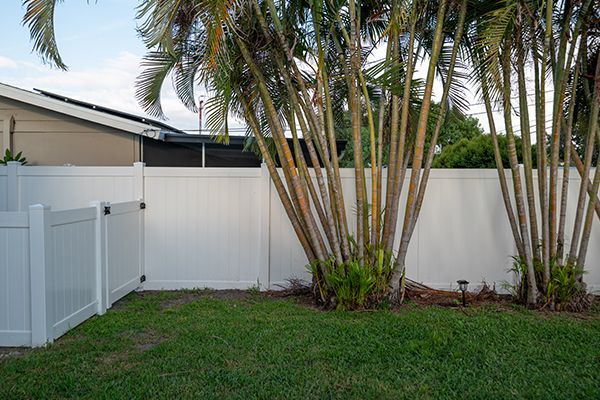
Vinyl is the material we install most often in Pinellas County, and the reason is boring in the best way. It does not need staining, it does not rot, and salt air does not attack it the way it attacks steel.
It is also the material most sensitive to installation quality. Vinyl moves with heat, so posts and panel sections have to be set with that movement in mind. A vinyl fence installed tight in July will complain by the following summer.
Where it struggles: full sun on a dark colour makes panels hot to the touch, and a direct impact cracks rather than dents. It is a privacy fence, not a barrier for a truck yard.
Wood: the one that looks best and asks the most
Wood gives you a natural finish no vinyl colour matches, and it is the easiest material to build to an odd height or a custom layout. Board-on-board, shadowbox, horizontal slat and ranch rail all come from the same material.
It also needs a finish and a look-over every couple of years in this climate, and posts are where it fails. Treated lumber to a ground-contact rating, set deep enough, is the difference between a fifteen-year fence and a seven-year one.
If you want wood and you do not want the upkeep, be honest about that at the estimate. It is cheaper to choose vinyl now than to resent a wood fence later.
Aluminum: the coastal specialist
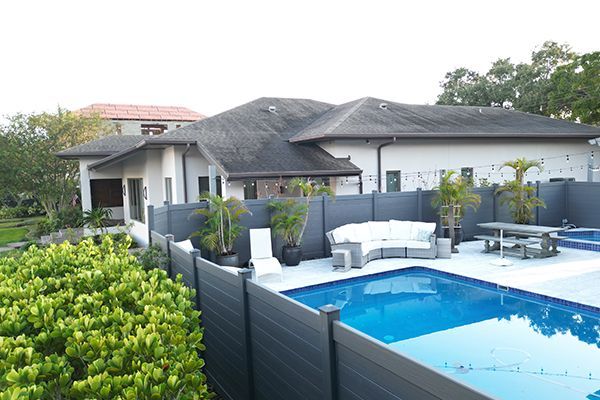
Aluminum does not rust, holds a powder-coated finish in salt air, and carries an open picket look that reads as an estate fence rather than a privacy screen. It is the right material for pool barriers, front entries and any run where you want to see through and still have a boundary.
It is not a privacy fence. It is also not the cheapest per foot, and the residential and industrial grades differ in wall thickness rather than appearance — worth knowing if a vehicle might back into the line.
What each material is bad at
Vinyl is bad at impact and at looking like wood. Wood is bad at staying maintenance-free. Aluminum is bad at privacy and at absorbing noise. Composite is bad at being inexpensive.
None of those are flaws exactly; they are the trade you make. The mistake is buying a material for a job it was never designed to do.
The mixed-material answer
Plenty of St. Petersburg yards want privacy on the side lines and an open look at the front. That is two materials, planned as one fence, with matching posts and a gate that ties them together.
We plan the whole perimeter at once so the transitions look deliberate, then phase the build if the budget needs it.
- Decide privacy, dog-proofing, curb appeal and maintenance before choosing material.
- Vinyl is the lowest-maintenance privacy option, and the most installation-sensitive.
- Wood looks best and needs a finish cycle; posts decide how long it lasts.
- Aluminum is the coastal choice for open, pool and entry fencing, not privacy.